I feel compelled to publish the DOG BITE SCALE made by Dr Ian Dunbar and used by professionals and law organizations all over the world.
This is in relation to New Zealand practices, which translate into euthanizing dogs as a result of any individual hysteria about alleged “aggression”. Reactivity doesn’t equal aggression, and a bite (or a nail scratch, or a warning, or the breed or even the “look” of the dog) does not, in a civilized country, equal death.
There are techniques grouped under TRAINING and REHABILITATION that are practiced everywhere on this world for a very long time. Sadly, those are foreign concepts to a large percentage of decisions makers in this country. Whether they are employees or volunteers, training and rehabilitation seems to be too complicate for their understanding, abilities and skills, and the dog pays the ultimate price.
A lot of supporters of undiscriminated euthanasia call themselves “rescues”, “shelters” and “trainers”. Death is not “rescue”. Death is not “saving” or “training” dogs. Nor “Management” of dogs. Nor providing “shelter”, either.
- Association of Professional Dog Trainers version: HOME – APDT International
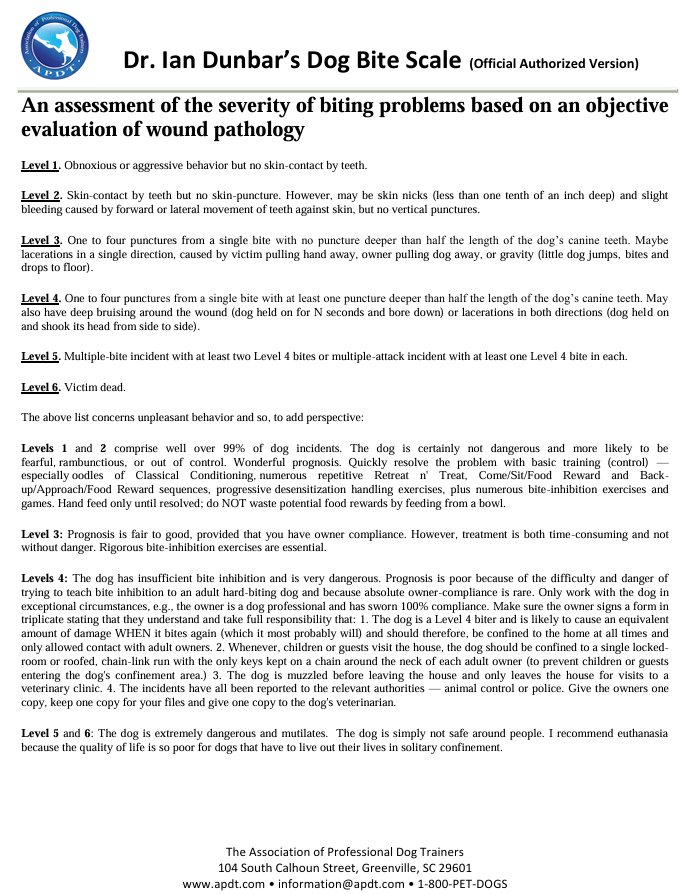
2. Original version by Dr. Ian Dunbar: How to Objectively Assess the Severity of Dog Bites
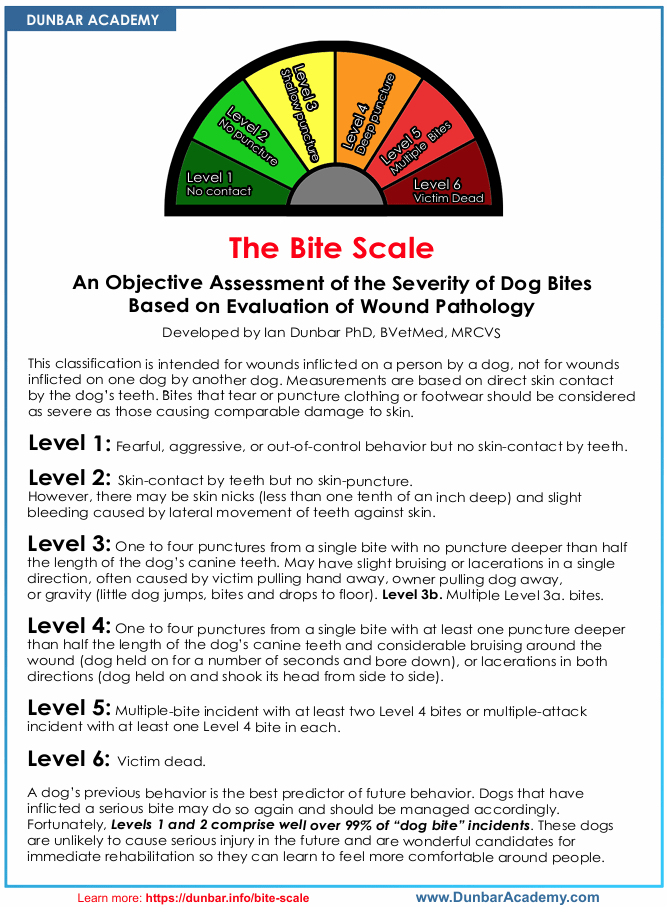
Dunbar Academy quote:
“You are welcome to share this document with anyone.
The Bite Scale was developed by Dr. Ian Dunbar as a tool for objectively assessing the severity of dog bites, because dog bites can be scary and emotional events and the descriptions provided by victims and witnesses can vary dramatically.
The Bite Scale removes as much subjectivity as possible by looking at quantifiable aspects of the physical wound that results from the bite.
Over the years, we have seen that when the Bite Scale is used to assess dog bites, the vast majority (Over 99%) of dog bites fall into Level 1 or 2, which is to say they do not break the skin. (For more information about the relative frequency of the different levels of dog bites, visit this page.)
Obviously, dog bites are not good, but there is a huge difference between a dog that bites without causing a significant injury and a dog whose bite breaks the skin and requires medical attention.
Past behavior is the best predictor of future behavior. Dogs that bite at Level 1 or 2 are in desperate need of training and socialization and they can often be rehabilitated quickly and safely.
Dogs that bite at Level 3 or above are also in desperate need of training and socialization, but rehabilitation will be inherently dangerous, and because of this, it will be much slower and more challenging.
For dogs that bite at Level 1 or 2, we strongly encourage you to enroll in the Top Dog Academy now, and make use of the many easy, effective, and safe training and socialization techniques.
For dogs that bite at Level 3 or above, your first priority must be safety and managing your dog’s environment and proximity to others in such a way that you can be sure that no one will get hurt.
Your next priority should be to immediately seek help from an Animal Behavior Consultant or Professional Dog Trainer who can evaluate your dog as an individual, ideally in-person.”
 JDC RESCUE - Jack Dog Center
Leave a comment